
 EN
EN












Founded in 657 BC by Megarian colonists at the tip of the Historic Peninsula, Byzantion forms the core of the urban texture that has reached today. After coming under Roman rule, the city developed aqueducts and infrastructure, and roads such as the Hipodrome and Mese began to emerge.
The walls built by Septimus Severus are thought to have extended along the slopes toward the Acropolis, running east of the present-day Hagia Sophia to the shore, merging with the sea walls. From 325 AD, the city of Constantinople, the eastern capital of the Roman Empire, developed with a hierarchical plan and defined functional centers.
The area facing the Marmara and Bosphorus formed the acropolis, housing palaces and administrative buildings. The surroundings were inhabited by the ruling and aristocratic class, while western neighborhoods housed the middle class. During Constantine’s era, the main structures were preserved, and the Septimus Severus walls were expanded. The southern façade of the Hippodrome integrated with the Great Palace.
Remains in Parcel 55, Block 33
In Alemdar, Fatih, during excavation in Parcel 55, Block 33, structural remains were identified. These remains were registered under the Cultural Preservation Committee decision No. 6555 on 04.05.1995. The T-shaped parcel has remains concentrated in two points:
-
Salkım Söğüt Street side → Remains No.1
-
Şengül Hamam Street side → Remains No.2
Remains No.1
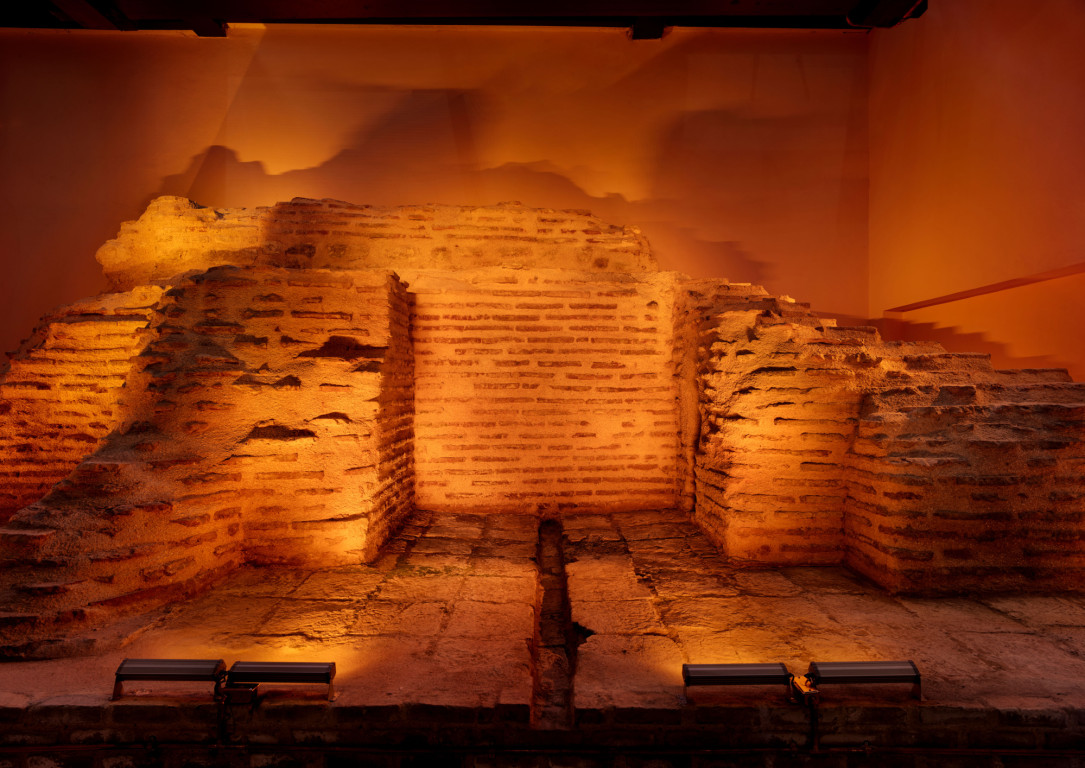
Located in the inset towards Salkım Söğüt Street at approximately -5.80 m, spreading over 7.80×9.97 m. The structure includes a wall parallel to the adjacent parcel, with varying thickness and terraced mass.
The wall is built with leaf bricks, large stone blocks, and horasan mortar. The lower stones measure about 0.65×0.43 m, while the upper part has a red-tile plaster surface. The curved forms may indicate a connection with a water structure.
Remains No.2
Located on the Şengül Hamam Street side, starting at -8.20 m and rising up to -5.59 m. The base is broad and narrows toward the street. The irregularities and brick-stone construction suggest a possible link to the hypocaust heating system of a bath.